
I was wrong about Gold IRAs.
For many years, I was skeptical about Gold IRAs. I viewed them as overly complicated and probably unnecessary for most people planning for retirement. After dedicating significant time to studying the topic, reviewing publicly available information, and speaking with various individuals in the retirement planning space, my perspective has shifted.
In this article, I share my honest evolution in thinking. Please note: Nothing in this post constitutes financial, tax, investment, or legal advice. I am not a financial advisor. Every individual’s situation is unique. You should always consult with your own qualified legal, financial, and tax professionals before making any decisions about your retirement accounts.
Affiliate Disclosure: This post may contain affiliate links, meaning we earn a commission if you purchase through them – at no extra cost to you. We only recommend products or services we believe add value to our readers. We advise that you conduct your own due diligence research prior to purchase.
My Earlier Perspective
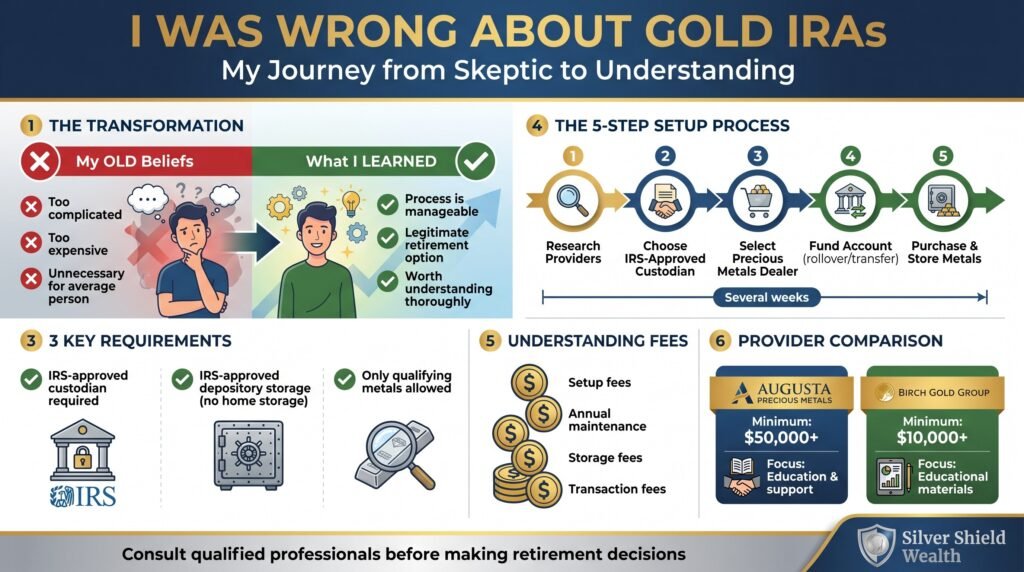
As many people focused on retirement planning, I primarily considered traditional investments such as stocks and bonds held in standard IRAs or 401(k)s. I assumed that adding physical precious metals to a retirement account would be difficult, expensive, and perhaps unnecessary.
I had several initial concerns:
- The process seemed more complex than for standard retirement accounts.
- I wondered about the fees involved in setup, storage, and ongoing account maintenance.
- I questioned whether this type of account made sense for the average person.
Over time, as I continued learning about self-directed retirement accounts and the specific rules governing them, I realized I had overlooked important details.
What Is a Gold IRA?
A Gold IRA is a type of self-directed Individual Retirement Account (IRA) that permits the holding of physical precious metals such as gold, silver, platinum, and palladium, provided they meet specific IRS purity and form requirements.
Unlike a traditional IRA, which typically holds stocks, bonds, or mutual funds, a Gold IRA holds physical assets. The account must follow strict IRS guidelines to maintain its tax-advantaged status.
Key requirements include:
- The account must be held by an IRS-approved custodian.
- The precious metals must be stored in an IRS-approved depository (home storage is not permitted).
- Only certain gold, silver, platinum, and palladium products qualify.
The setup generally involves rolling over or transferring funds from an existing retirement account. This process, when done correctly in accordance with IRS rules, can be completed without immediate tax consequences.
The Rollover Process: Step by Step
Setting up a Gold IRA typically follows these general steps:
- Research and Select Providers. Individuals often start by reviewing educational materials from different companies specializing in this area.
- Choose an IRS-Approved Custodian. This is one of the most important decisions. The custodian handles account administration, IRS reporting, and compliance.
- Select a Precious Metals Dealer. The dealer helps identify IRS-approved products.
- Fund the Account. This is usually done through a direct rollover or transfer from an existing IRA or qualified retirement plan.
- Purchase and Store the Metals. The custodian coordinates the purchase and arranges storage in an approved depository.
The entire process can take several weeks, depending on the complexity of the rollover and the responsiveness of the parties involved.
Why Custodian Selection Matters
Choosing the right custodian is widely regarded as one of the most critical parts of establishing a Gold IRA. The custodian acts as the trustee of your account and is responsible for ensuring all transactions comply with IRS regulations.
Key Factors to Consider When Evaluating Custodians:
- IRS Approval and Experience: The custodian must be properly approved by the IRS to hold self-directed retirement accounts. Look for institutions with specific experience managing precious metals IRAs rather than just traditional accounts.
- Reputation and Longevity: Many people review how long the custodian has been operating and any available feedback from account holders.
- Fee Structure: Custodians charge various fees, including setup, annual maintenance, storage, and transaction fees. It is advisable to request a complete, written fee schedule before proceeding.
- Storage Options: Reputable custodians partner with IRS-approved depositories. Common considerations include whether the metals are stored in segregated (specifically allocated to your account) or non-segregated arrangements, as well as the security measures and insurance coverage of the depository.
- Customer Service and Transparency: Some custodians offer online account access, clear reporting, and responsive support year-round.
- Account Minimums: Different custodians and partnering companies have varying minimum investment requirements.
Because the custodian plays such a central role in the ongoing compliance and administration of the account, many individuals take time to compare options carefully and ask detailed questions before making a decision.
Working with Precious Metals Dealers
Once a custodian is selected, the next step is often choosing a dealer specializing in IRS-approved precious metals for retirement accounts. Dealers can provide information about eligible products, current pricing, and the purchasing process.
Some companies in this space focus heavily on customer education and transparent processes. Two companies that frequently appear in discussions are Augusta Precious Metals and Birch Gold Group.
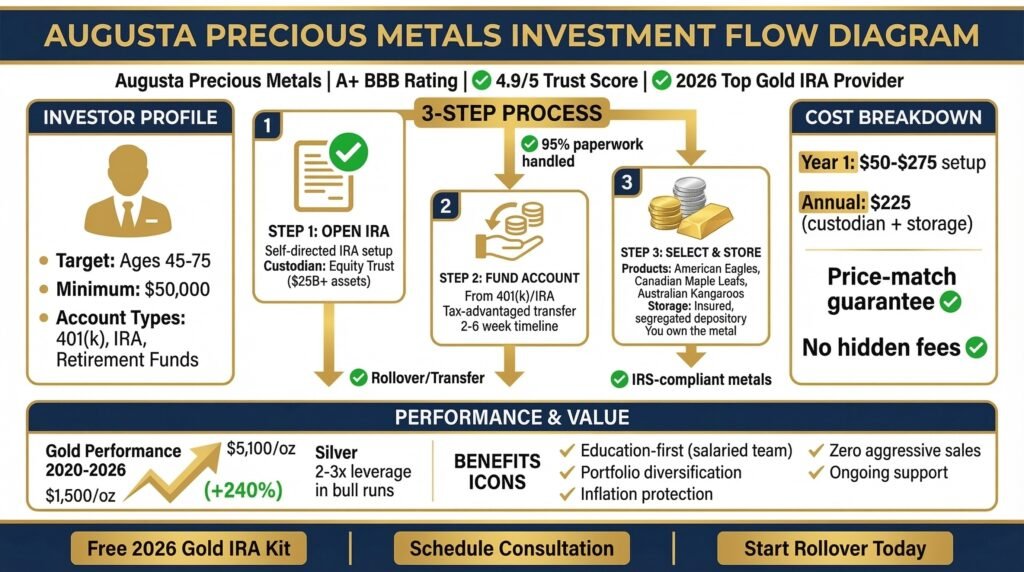
Augusta is known for working with clients who are considering larger account sizes, often starting at $50,000 or more. They place strong emphasis on educational resources and detailed explanations of the account setup process. Many people appreciate the level of support they provide during the initial stages.
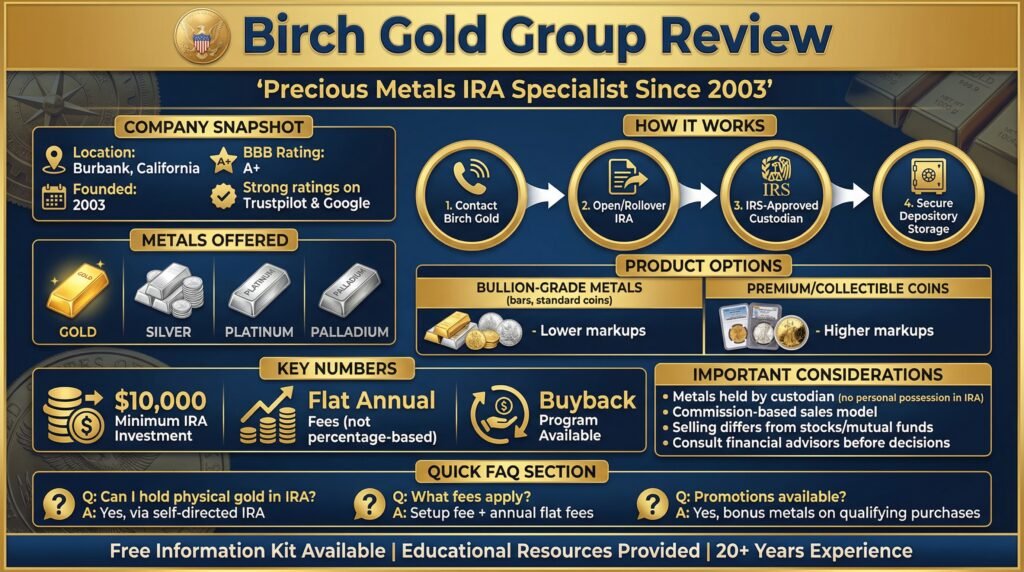
Birch Gold Group works with investors across a range of account sizes, from approximately $10,000 and up. They have built a reputation over many years and also provide educational materials to help individuals understand the process.
Both companies partner with custodians and depositories as part of the account setup. Anyone interested should review their materials directly and ask questions to determine what best fits their individual circumstances.
Understanding Fees and Costs
Fees vary significantly between different providers and custodians. Common types of fees include:
- One-time setup or account opening fees
- Annual administrative or maintenance fees
- Storage fees (often charged by the depository)
- Transaction or spread fees on metal purchases
It is considered best practice to request a full written breakdown of all potential fees before opening an account. Some providers offer fee waivers or reduced rates for larger accounts.
Important Considerations for Anyone Exploring This Option
Setting up and maintaining a Gold IRA involves multiple parties working together: the account owner, the custodian, the dealer, and the depository. Clear communication between all parties helps ensure the process runs smoothly and remains compliant with IRS rules.
Not every individual will find this type of account suitable. Factors such as overall retirement goals, existing savings, and personal circumstances all play a role. This is why consulting with your own team of qualified professionals is strongly recommended.
Past performance of precious metals prices is not indicative of future results. No one can predict with certainty how prices will move in the future.
Final Thoughts
I was wrong to dismiss Gold IRAs without taking the time to understand them more thoroughly. There are legitimate reasons why some individuals choose to explore this type of retirement account.
At Silver Shield Wealth, we believe in careful stewardship and making informed decisions based on thorough research. We encourage readers to take their time, review available educational materials, ask good questions, and work only with companies that emphasize transparency.
If you would like to learn more:
- For accounts typically starting from $50,000+, many people review the resources offered by Augusta Precious Metals.
- For accounts starting at approximately $10,000+, Birch Gold Group is another company that offers educational materials.
Important Disclaimer: This article is provided for informational and educational purposes only. We are not financial, tax, or investment advisors. Nothing contained herein should be construed as advice. Past performance is not a guarantee of future results. Always consult with your own qualified legal, financial, and tax professionals before making any decisions regarding your retirement accounts or investments.
What questions do you have about the Gold IRA process? Feel free to leave a comment below.
Leave a Reply