

Could Funeral Expenses Disrupt Your Family’s Retirement Security?
A retirement plan is designed to provide income, preserve financial independence, and protect the people you love. Final expenses planning is key to protecting your family.
You may have carefully considered Social Security, pensions, investment income, healthcare costs, inflation, taxes, and the legacy you hope to leave your family. But another expense is often left out of retirement planning: the cost of your funeral and other final obligations.
These expenses can arrive suddenly and require payment when your family is grieving.
If money is not readily available, a surviving spouse or adult child may have to use emergency savings, borrow money, carry a credit-card balance, or sell investments at an inconvenient time.
Planning for final expenses is therefore not merely about paying for a funeral. It is about protecting liquidity, preserving retirement assets, and giving your family time to make thoughtful decisions rather than urgent financial ones.
What are final expenses?
Final expenses include the costs associated with a person’s death and the administration of their immediate affairs.
They may include:
- Funeral-home services
- Burial or cremation
- A casket, urn, or alternative container
- Transportation and preparation of the deceased
- A viewing, funeral, or memorial service
- A cemetery plot
- Grave opening and closing
- A burial vault
- A headstone or memorial marker
- Flowers, programs, and obituary notices
- Death certificates
- Travel and accommodation for close family members
- Outstanding household bills
- Unpaid medical expenses
- Legal and accounting costs
- Estate-administration expenses
- Temporary support for a surviving spouse or dependent
- Pet care or rehoming costs
Some of these expenses may be modest. Others can create a substantial immediate demand for cash.
The total will depend on the type of arrangements chosen, the location, the funeral provider, cemetery costs, religious or cultural traditions, and the complexity of the estate.
How much could a funeral cost?
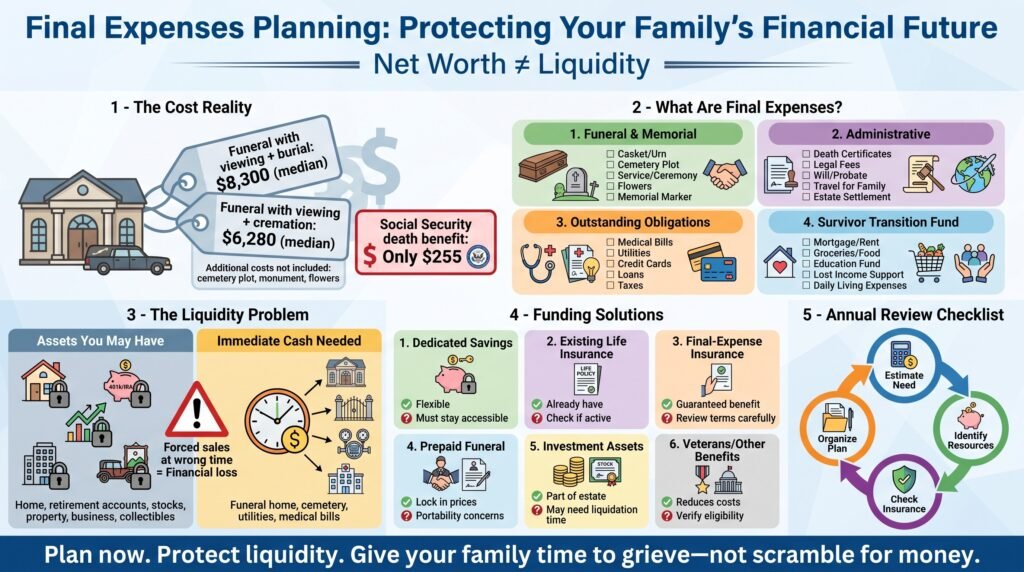
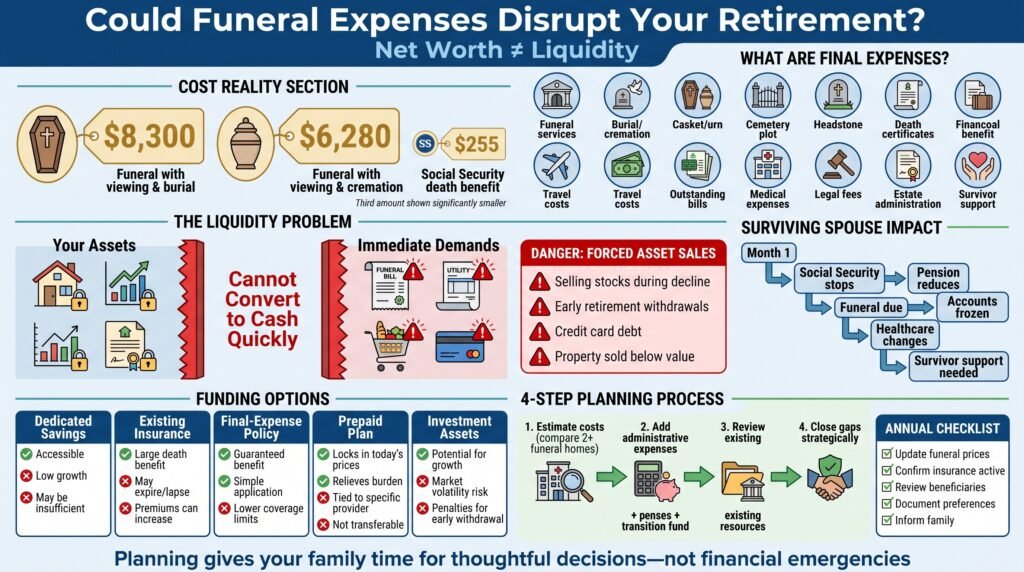
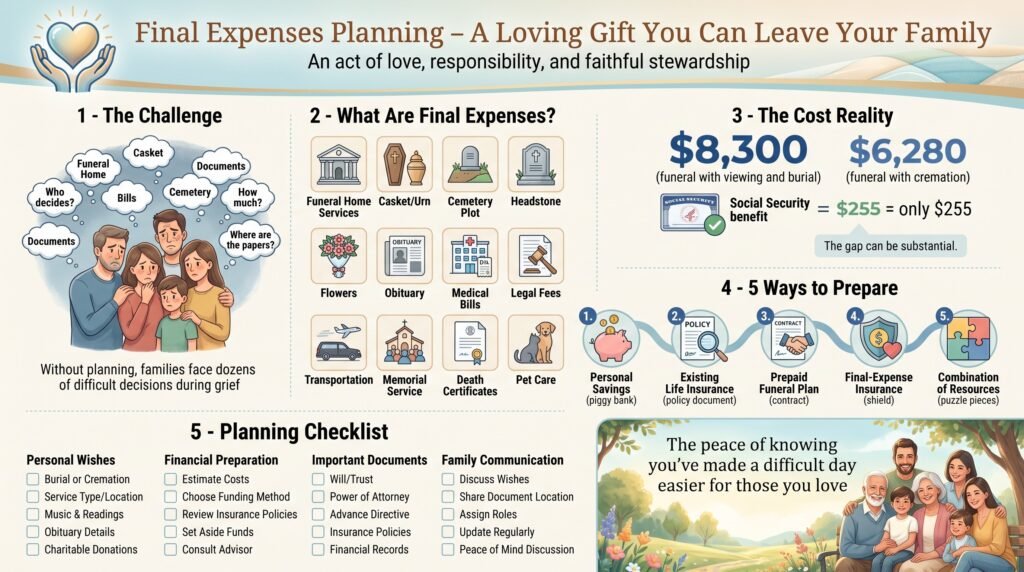
The National Funeral Directors Association’s 2023 pricing study reported a national median cost of $8,300 for a funeral with viewing and burial. Its reported median for a funeral with viewing and cremation was $6,280. Some additional costs—such as a cemetery plot, grave opening and closing, monument, flowers, or obituary—may fall outside these totals. National Funeral Directors Association
A simple direct cremation may cost considerably less, while an elaborate funeral and burial may cost substantially more.
This does not mean every retiree needs to set aside the same amount. It means final expenses should be estimated intentionally, not ignored.
A useful estimate begins with the arrangements you would prefer and the actual prices charged by providers in your area.
Why final expenses can disrupt a retirement plan
A family may have significant net worth but limited immediately accessible cash.
For example, retirement wealth may be held in:
- A home
- Traditional or Roth retirement accounts
- An employer pension
- Annuities
- Stocks and bonds
- Certificates of deposit
- Precious metals
- Rental property
- A business
- Collectibles or other physical assets
These assets may support a sound long-term financial plan, but not all of them can be converted into cash quickly or conveniently.
A funeral provider, cemetery, credit-card company, or utility provider may not be willing to wait while the family sells a property, completes probate, transfers an investment account, or files an insurance claim.
This creates a distinction that every retirement plan should recognize:
Net worth is not the same as liquidity.
A family can be financially secure on paper and still struggle to meet immediate expenses.
The danger of a forced asset sale
When money is needed quickly, the family may have to sell whatever can be accessed first.
That could mean:
- Selling stocks during a market decline
- Liquidating precious metals at an unfavorable price
- Cashing out a certificate of deposit early
- Withdrawing more than planned from a retirement account
- Selling sentimental property below its value
- Borrowing against the home
- Carrying high-interest credit-card debt
The problem is not necessarily that these assets should never be sold. The problem is being forced to sell them without adequate time to compare choices, consider taxes, or wait for more favorable conditions.
A dedicated source of final-expense liquidity can give the family breathing room.
It may allow longer-term assets to remain invested until decisions can be made as part of the broader estate and retirement plan.
Do not assume Social Security will pay for the funeral.
Social Security may pay a surviving spouse—or in certain circumstances an eligible child—a one-time lump-sum death payment of $255.
Not every family is eligible for the payment, and an eligible survivor generally must apply within two years of the death. Social Security Administration
Even when available, $255 is unlikely to cover more than a small portion of funeral and burial costs.
Monthly survivor benefits are separate from this lump-sum payment. Eligibility depends on the deceased person’s work record and the survivor’s circumstances.
Surviving spouses should investigate all benefits for which they may qualify, but a retirement plan should not assume that government benefits will provide immediate payment for the funeral.
The month-of-death Social Security issue
Families should also understand that Social Security payments generally do not continue automatically after a beneficiary dies.
According to USAGov, the funeral director will often report the death to the Social Security Administration. Any benefit payment received for the month of death may need to be returned because Social Security benefits are not payable for the month in which the beneficiary dies. USAGov guidance after a death
A surviving spouse who has relied heavily on the deceased spouse’s monthly payment may therefore experience an immediate change in household cash flow.
This makes it important to consider not only the funeral bill, but also the surviving spouse’s financial position during the first several months after the death.
Final-expense planning and the surviving spouse
The death of one spouse can alter a retirement plan in several ways:
- One Social Security payment may stop.
- Pension income may be reduced or end.
- Healthcare coverage may change.
- Household expenses may not fall as quickly as income.
- Certain accounts may be temporarily inaccessible.
- Property and account titles may need to be changed.
- The surviving spouse may require professional assistance.
- Investment and tax decisions may need to be made.
- Funeral and travel costs may arrive immediately.
A surviving spouse should not have to choose between paying for a funeral and meeting ordinary living expenses.
When estimating final-expense needs, consider creating a temporary financial cushion in addition to the expected funeral cost.
That cushion could help cover housing, utilities, food, transportation, professional fees, and other expenses while accounts and benefits are being reorganized.
How much should you prepare?
No universal amount suits every retiree.
A practical target can be developed by estimating four categories:
1. Funeral and memorial arrangements
Estimate the cost of the burial, cremation, funeral, memorial, cemetery, and related services you would prefer.
2. Immediate administrative expenses
Include death certificates, legal consultations, property security, travel, postage, and other expenses incurred while notifying organizations and managing the estate.
3. Outstanding personal obligations
Consider medical bills, household accounts, credit cards, and recurring payments that may continue temporarily.
4. Survivor transition fund
Determine whether a spouse or dependent may need additional funds while benefits, accounts, property, and income sources are transferred.
The total should be reviewed periodically. Funeral prices, family needs, health, insurance, and retirement assets can change.
Compare local funeral prices before setting a target.
You do not have to wait for a death to request funeral prices.
The Federal Trade Commission’s Funeral Rule gives consumers the right to request price information by telephone. When visiting a funeral home, you have the right to receive a written General Price List showing the goods and services offered and their prices.
Consumers may also purchase individual goods and services rather than accepting a package containing unwanted items. FTC Funeral Rule
Consider contacting at least two funeral homes and asking for pricing that matches your preferences.
Compare:
- Basic services fees
- Transportation
- Embalming and preparation
- Viewing and service facilities
- Burial or cremation charges
- Casket or urn prices
- Cemetery charges
- Outer burial containers
- Obituary and flower expenses
- Cash-advance items
- Possible additional fees
The objective is not to automatically select the cheapest arrangement. It is to understand the likely cost and prevent your family from making every decision without guidance.
Options for funding final expenses
Final expenses can be funded in several ways. Each has advantages, limitations, and risks.
| Dedicated savings | Flexible and easy to understand | Will enough money remain available and accessible? |
| Existing life insurance | May already provide a death benefit | Is the policy active, sufficient, and permanent? |
| Final-expense insurance | Specifically creates a death benefit | Premiums, eligibility, waiting periods, and exclusions vary |
| Prepaid funeral plan | Allows arrangements to be selected in advance | Portability, refunds, guarantees, and provider failure must be considered |
| Investment assets | May already be part of the estate | Value may fluctuate and access could be delayed |
| Family resources | May provide flexibility | Can create an unexpected burden or disagreement |
| Veterans or other benefits | May reduce certain expenses | Eligibility and covered costs must be confirmed |
Some retirees use one method, while others combine several.
Option 1: Dedicated cash savings
A dedicated savings account can provide flexibility and immediate liquidity.
Advantages may include:
- Straightforward funding
- No health qualification
- Freedom to use the money for different expenses
- The ability to increase the balance over time
- No insurance waiting period
However, the plan works only if the money remains available.
Consider:
- Who owns the account?
- Can the appropriate person access it after death?
- Will the account pass through probate?
- Could the money be spent for another purpose?
- Does the balance keep pace with inflation?
- Is the account clearly documented?
Do not add another person as a joint owner without understanding the legal, tax, creditor, and estate consequences. Ask a qualified professional about payable-on-death designations or other arrangements available in your state.
Option 2: Existing life insurance
Before buying anything new, review the coverage you already have.
You may hold:
- Term life insurance
- Whole life insurance
- Universal life insurance
- Employer-provided group coverage
- Union coverage
- Veterans’ coverage
- A policy purchased many years ago.
Confirm:
- Whether the policy is active
- When coverage ends
- Whether premiums can increase
- The current death benefit
- Any outstanding policy loans
- Current beneficiaries
- Whether the policy depends on employment
- How the claim process works
- Whether beneficiaries know the policy exists
A term policy may offer substantial coverage during its term, but it may expire before the end of your life. Employer coverage may end or change when employment ends. Permanent policies can also lapse if required premiums are not paid.
An annual policy review is more dependable than relying on old statements or memory.
Option 3: Final-expense insurance
Final-expense insurance—also called burial or funeral insurance—is generally a smaller life-insurance policy marketed to help beneficiaries pay for funeral and other end-of-life expenses.
Many policies are forms of permanent life insurance, although terms differ by insurer and state.
Potential features may include:
- A death benefit paid to a named beneficiary
- Coverage intended for a relatively modest financial need
- Simplified underwriting on some policies
- Premiums designed to remain level on certain policies
- Coverage that does not expire at the end of a fixed term, provided policy requirements are met.
Important questions include:
- What is the full death benefit?
- How much will the premiums cost?
- Are premiums guaranteed to remain level?
- How long must premiums be paid?
- Are health questions required?
- Is a medical examination required?
- Is there a waiting or graded-benefit period?
- What happens if death occurs during that period?
- Which causes of death are excluded or limited?
- Is there a cash value?
- What happens if payments are missed?
- Can policy loans reduce the death benefit?
- Does the coverage increase with inflation?
- What cancellation or free-look rights apply?
Guaranteed-issue policies may be available without medical questions, but they can cost more and may limit the benefit for nonaccidental death during the policy’s early years.
“Guaranteed acceptance” should never be interpreted as a guarantee that the full benefit is immediately payable in every circumstance.
Option 4: Prepaid funeral arrangements
A prepaid or “preneed” funeral plan allows a person to select and pay for funeral goods or services before death.
This can provide several benefits:
- Your preferences are recorded.
- Certain decisions are made in advance.
- Your family knows which provider to contact.
- Some prices may be guaranteed.
But you must review the contract carefully.
The FTC recommends asking:
- What goods and services are included?
- What happens to the prepaid money?
- Are prices guaranteed?
- Can the plan be transferred if you move?
- Is there an additional transfer fee?
- Can the agreement be canceled?
- Is a refund available?
- What happens if the provider closes?
- What happens if death occurs away from home?
- Does the contract cover merchandise, services, or both?
States regulate prepaid funeral arrangements differently. Never assume every charge is guaranteed unless the contract says so clearly.
Tell your family about any prepaid arrangement and store the contract with your other important documents. Otherwise, they could pay another provider without knowing that services had already been purchased. FTC planning guidance
Option 5: Investment and retirement assets
Retirees with adequate assets may choose to self-fund final expenses.
This may be reasonable, but the plan should identify which assets are intended to provide the money and how they can be accessed.
Questions include:
- Are the assets liquid?
- How quickly can ownership be transferred?
- Would a sale create taxes or penalties?
- Could market conditions affect the amount available?
- Does the surviving spouse know where the assets are?
- Are account titles and beneficiaries correct?
- Will the family need authorization from an executor or court?
- Could the assets be required for the surviving spouse’s retirement income?
Precious metals, property, securities, and other investments can play valuable long-term roles, but they are not substitutes for immediate cash unless a practical liquidation plan exists.
A financially resilient retirement strategy generally separates near-term liquidity from long-term investments.
The risk of paying premiums for many years
When considering final-expense insurance, compare the potential benefit with the total premiums you may pay.
For example, a person who purchases coverage at a relatively young age and pays premiums for several decades could eventually pay an amount approaching—or even exceeding—the policy’s death benefit.
That does not automatically make the policy unsuitable. Insurance transfers the risk that death could occur before sufficient savings have accumulated. It may provide immediate coverage that a new savings plan cannot.
However, consumers should understand the trade-off.
Ask the agent for:
- The guaranteed death benefit
- The guaranteed premium
- The premium-payment duration
- A policy illustration where applicable
- Any non-guaranteed values
- The consequences of cancellation
- The projected and guaranteed cash values
- The total premiums at different ages
Compare this with alternatives such as dedicated savings or using existing insurance.
Beware of emotional and high-pressure selling.
Final-expense advertising often uses emotionally powerful language:
- “Do not burden your children.”
- “Everyone is accepted.”
- “Rates may be only pennies a day.”
- “This government-approved program is available in your state.”
- “Call immediately before benefits expire.”
Do not let urgency replace careful evaluation.
Insurance products are issued by insurance companies—not by Social Security, Medicare, or the federal government. A mailing that resembles an official government notice may still be an insurance solicitation.
Before purchasing coverage:
- Confirm the agent’s identity and license.
- Identify the insurance company.
- Request written policy information.
- Understand all limitations.
- Compare more than one option.
- Never provide financial information to an unverified caller.
- Do not sign an incomplete application.
- Review the policy during the available free-look period.
- Keep copies of everything submitted.
A reputable agent should be willing to explain the policy without pressuring you into an immediate decision.
Coordinate final-expense planning with your estate plan.
Final-expense arrangements should not exist separately from the rest of your financial plan.
Review them alongside:
- Your will
- Trust documents
- Powers of attorney
- Healthcare directives
- Life-insurance beneficiaries
- Retirement-account beneficiaries
- Bank-account designations
- Property ownership
- Digital assets
- Business succession plans
- Pet-care instructions
- Funeral preferences
Make sure the people who need the information can find it.
Keep a concise master record containing:
- Insurance policy numbers
- Company and agent contacts
- Account locations
- Funeral and cemetery contracts
- Military records
- Legal adviser information
- Executor contact details
- Funeral preferences
- Instructions for obtaining death certificates
- People and organizations to notify
Avoid including passwords or highly sensitive information in an unsecured document. Use an appropriate secure method and tell your executor or trusted family member how to access it.
Review beneficiary designations
Beneficiary designations can determine who receives life-insurance and retirement-account proceeds.
Review beneficiaries after:
- Marriage
- Divorce
- Remarriage
- The birth or adoption of a child
- The death of a beneficiary
- Family estrangement
- A major change in financial circumstances
- A change in your estate plan
Check both primary and contingent beneficiaries.
Naming your estate as the beneficiary may have different probate, creditor, and tax consequences from naming an individual. Naming a minor can also create complications.
Do not make beneficiary decisions based solely on general information. Obtain estate-planning, legal, and tax guidance appropriate to your circumstances.
Questions to ask before purchasing final-expense coverage
Take this list into any conversation with an insurance agent:
- Which insurance company issues the policy?
- Is the company licensed in my state?
- What type of life insurance is this?
- What is the guaranteed death benefit?
- What will I pay monthly and annually?
- Can the premium ever increase?
- How long must I pay premiums?
- Is there a waiting or graded-benefit period?
- What is paid if I die during that period?
- Are accidental and nonaccidental deaths treated differently?
- Which exclusions apply?
- Can the policy lapse?
- Does it build cash value?
- Can loans or withdrawals reduce the benefit?
- Does the benefit adjust for inflation?
- What happens if I cancel?
- How long is the free-look period?
- How does this policy compare with using my existing insurance or savings?
Do not purchase a policy until you can explain its essential terms in your own words.
A practical final-expense review
Use this annual checklist:
Estimate the need
- Review local funeral and cemetery prices.
- Record burial or cremation preferences.
- Estimate additional final obligations.
- Include a temporary survivor cash reserve.
Identify available resources
- List dedicated savings.
- Review existing life-insurance coverage.
- Confirm veterans or employer benefits.
- Review prepaid arrangements.
- Identify liquid assets you can access.
Check insurance
- Confirm every policy remains active.
- Review premiums and benefit amounts.
- Check waiting periods and exclusions.
- Update primary and contingent beneficiaries.
- Tell beneficiaries where policy information is stored.
Organize the plan
- Document funeral preferences.
- Coordinate instructions with your estate plan.
- Give appropriate information to your executor.
- Store records securely.
- Discuss the plan with your spouse and adult children.
Final expenses are a liquidity issue.
A strong retirement plan does more than accumulate assets. It prepares for the moments when you’ll need money.
Final expenses represent one of those moments.
Whether you use savings, existing insurance, final-expense coverage, prepaid arrangements, or a combination, the objective is the same: provide accessible funds without unnecessarily disrupting the surviving spouse’s retirement or forcing the family to sell long-term assets under pressure.
Begin by estimating the need. Then identify the resources already available. Close any realistic gap with the approach that best suits your health, age, family, budget, and broader financial plan.
The amount involved may be small compared with an entire retirement portfolio, but the absence of a plan can cause disproportionate stress.
Preparing now gives your family something more valuable than money alone: time, clarity, and the freedom to make thoughtful decisions while honoring your wishes.
Could Final Expenses Create a Gap in Your Retirement Plan?
A licensed insurance agent can explain final-expense coverage options that may be available in your state and help you compare premiums, benefit amounts, waiting periods, and policy limitations.
[Speak With a Licensed Insurance Agent]
Coverage, premiums, eligibility, and policy features vary by applicant, insurer, and state. Some policies include health questions, exclusions, limitations, or graded death benefits. Speaking with an agent does not obligate you to purchase coverage.
This article is for general educational purposes and does not constitute investment, financial, legal, tax, estate-planning, or insurance advice. Consult appropriately qualified professionals regarding your individual circumstances.
Leave a Reply