

Calm Confidence in Retirement with Resilient Purpose. Building a Retirement Life That Is Rich in More Than Money. Learn how purpose, preparation, gratitude, and steady action can help you face retirement uncertainty with confidence and build a life rich in more than money.
Retirement is often presented as a financial finish line. Work hard, save consistently, accumulate enough, and one day you will arrive at a place called security.
Real life is more complicated.
Markets move. Costs rise. Health changes. Family members need help. Plans made years ago may no longer fit the world we live in now. Even people who have prepared carefully can feel unsettled when headlines warn of storms, wars, earthquakes, inflation, recession, political conflict, banking stress, or another threat to their savings.
Financial preparation matters enormously. Yet numbers alone cannot create peace. A person can have substantial assets and still be ruled by fear, while another can face genuine limitations with remarkable clarity, gratitude, and strength.
The goal, therefore, is not merely to accumulate wealth. It is to build a retirement life supported by prudent resources, wise habits, emotional resilience, strong relationships, faith, and a clear sense of purpose. True wealth is not one number on a statement. It is the ability to face uncertainty without surrendering your judgment, values, or hope.
Calm Confidence in Retirement with Resilient Purpose.
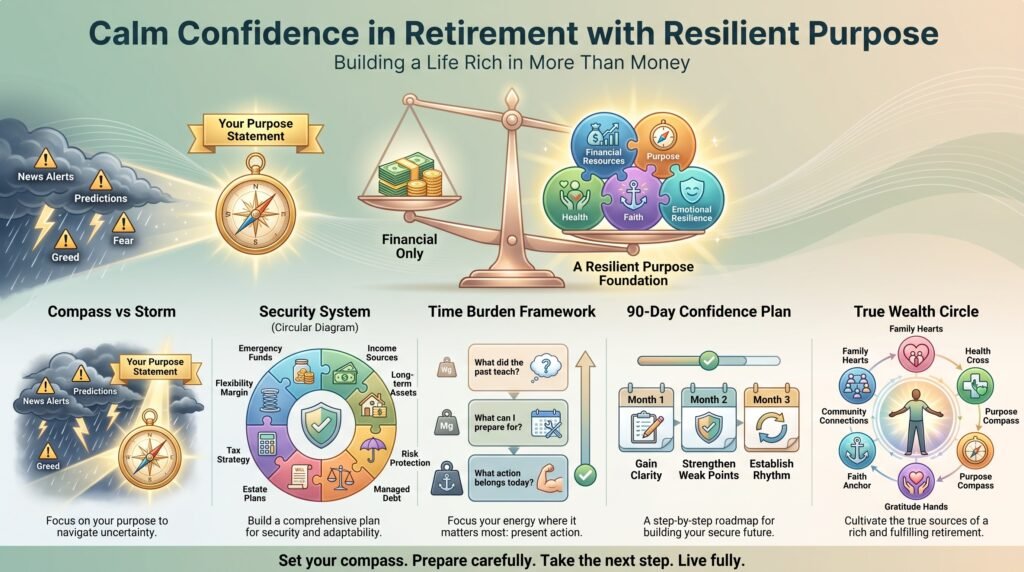
Begin With a Compass, Not the Daily Storm
The modern financial world is a storm of information. News alerts, market predictions, advertisements, social media opinions, and urgent emails all compete for attention. One expert says a crisis is imminent; another promises an extraordinary opportunity. Fear tells us to wait. Greed tells us that waiting will cause us to miss out.
Noise creates reaction. A compass creates direction.
Your retirement compass clearly states what your money is meant to accomplish. It may be:
“I want dependable resources, appropriate protection, and enough flexibility to care for my family, live with dignity, and give generously without taking risks I do not understand.”
That sentence is more useful than a prediction about what one asset may do next month. It helps you judge every decision against your actual purpose. To achieve calm confidence in your
Before reacting to a headline, ask:
- Does this information affect my long-term plan or merely my emotions today?
- Do I understand the opportunity, cost, liquidity, and risk?
- Does it improve diversification, or am I concentrating too heavily in one idea?
- Am I acting from evidence and purpose, or from fear of loss and fear of missing out?
- Would I make the same decision after a quiet night’s sleep?
The loudest message is rarely the wisest. Give your best attention to your compass before letting the storm determine your course.
Security Is a System, Not a Single Product
It is tempting to search for one perfect investment that will remove uncertainty. No asset solves every problem in every season.
Cash provides immediate access but can lose purchasing power over time. Shares can support long-term growth but fluctuate. Bonds may produce income and stability but carry interest-rate and credit risks. Property can create income and tangible value but also demands maintenance, management, and patience with liquidity. Precious metals may add diversification and serve as a long-term store-of-value component, but demand patience with liquidity.
A resilient retirement plan recognizes that different resources have different jobs. Security comes from how the pieces work together.
This is why a sensible plan often considers:
- accessible emergency funds;
- dependable income sources;
- diversified long-term assets;
- protection against major risks;
- manageable debt and expenses;
- estate and beneficiary arrangements;
- tax implications;
- and a margin for circumstances nobody can predict perfectly.
Diversification is not a guarantee against loss, but it can reduce dependence on a single outcome. The objective is not to predict every storm. It is to build a vessel that can weather many kinds of storms.
Protect Your Mind Before You Protect Your Portfolio
Markets do not experience fear; people do. A falling number can trigger anxiety, regret, anger, or the urge to “do something” immediately. Rising prices can create overconfidence and tempt us to abandon discipline.
Strong financial decisions begin with emotional awareness.
Notice what happens inside you when uncertainty rises. Do you check prices repeatedly? Do you seek only opinions that confirm what you already believe? Do you become vulnerable to dramatic claims? Do you avoid reviewing your position because the subject feels uncomfortable?
None of these responses makes you foolish. They make you human. But you should acknowledge emotions without letting them take charge.
Create space between a feeling and a consequential decision. Write down what has changed. Distinguish a temporary price movement from a permanent change in your needs or circumstances. Revisit your time horizon and the role that each asset is meant to play. Consult an appropriately qualified professional when a decision involves tax, pensions, estate planning, or risks you do not fully understand.
Patience is not passivity. It is disciplined thought under pressure.
Carry Today’s Burden—Not Three Days at Once
Many retirement worries combine three different time periods into one heavy burden.
We carry regret about yesterday: “I should have saved more. I should have bought earlier. I should not have sold.” We carry fear about tomorrow: “What if inflation remains high? What if I live longer than expected? What if my family needs help?” Then we try to solve it all emotionally today.
The past can teach, but you can’t trade it again. Review it for lessons, not for self-punishment. Perhaps you learned that concentration creates stress, that promises of easy returns deserve caution, or that postponing difficult conversations increases risk. Turn those insights into better rules.
The future deserves preparation, not endless rehearsal of disaster. Identify realistic risks and decide what you can do now. Update a budget. Check beneficiaries. Review insurance. Build a cash buffer. Discuss plans with a spouse. Seek advice. Then release what you can’t solve today.
Ask three questions:
- What did the past teach me?
- What future risk can I prepare for responsibly?
- What useful action belongs to today?
Clarity often returns when we stop trying to carry every possible future at once.
Small Financial Actions Become Powerful Through Consistency
Major financial goals can feel intimidating because the final number is so much larger than the next contribution. Yet nearly every substantial reserve, debt reduction, or investment portfolio was built through many ordinary decisions.
A monthly contribution may seem small. A modest reduction in recurring expenses may not feel life-changing. Organizing documents for thirty minutes may appear insignificant. But repeated actions compound – not only in money, but also in confidence and capability.
Consider the power of simple habits:
- reviewing spending once a month;
- automating an affordable contribution;
- increasing savings when income rises;
- questioning high fees;
- learning one financial concept at a time;
- maintaining a list of accounts and important contacts;
- discussing money openly with your spouse;
- and checking whether your plan still reflects your life.
Do not wait for perfect motivation. Action often creates motivation. Complete one task that reduces uncertainty. Momentum grows when you prove to yourself that the situation is not beyond your influence.
Define What “Enough” Means
Without defining enough, wealth can become an endless pursuit. Every milestone moves, every comparison creates dissatisfaction, and every person with more becomes evidence that we have less.
Run your own race.
Your needs, responsibilities, health, family structure, location, values, and desired lifestyle are not the same as anyone else’s. A neighbor’s investment, a colleague’s retirement date, or an online personality’s claim does not define your path.
“Enough” is not necessarily a fixed or simple number. It is a thoughtful relationship between resources and purpose. It asks:
- What standard of living matters to us?
- Which expenses are essential, meaningful, or optional?
- What risks must we be able to absorb?
- Whom do we hope to help?
- What experiences do we value?
- What kind of legacy do we want to leave?
When enough is connected to purpose, money returns to its proper role: a tool. It can purchase shelter, care, freedom, time, education, generosity, and experience. It cannot purchase a loving family, integrity, peace with God, or the knowledge that your life made another person stronger.
Purpose Does Not Retire When Employment Ends
One of the hidden challenges of retirement is not financial. Work may have supplied structure, identity, relationships, goals, and a reason to be needed. When employment ends, a person can have sufficient income and still feel disoriented.
Retirement should not mean retiring from meaning.
Experience accumulated over decades is valuable. You may mentor someone, serve in a church or community, support grandchildren, develop a long-neglected talent, build a small enterprise, write, teach, volunteer, travel, garden, create, or become the reliable person who notices when others need encouragement.
Purpose is not measured only by scale. Helping one person matters. Caring faithfully for a spouse matters. Sharing wisdom that prevents another person’s mistake matters. Creating a peaceful home matters.
Ask, “What do I have in my hand now?” You may have time, knowledge, relationships, faith, patience, a practical skill, or the ability to listen. Purpose often begins with what is already available.
Your Health Is Part of Your Wealth
Financial plans frequently measure longevity as a risk: How long must the money last? But a long life is not merely a liability on a spreadsheet. It is time – time to love, learn, contribute, and experience.
Health cannot always be controlled, and illness should never be treated as a moral failure. Still, appropriate movement, nourishing food, sleep, medical care, social contact, and mental stimulation can support the quality of the years ahead.
Treat health decisions as seriously as financial ones. A portfolio is intended to serve a life. It makes little sense to protect every asset while neglecting the person those assets were built for.
Rest also belongs in a successful life. There is a time to press forward and a time to pause; both can be acts of strength. Rest restores judgment and protects us from decisions made in exhaustion.
The People Around You Are Part of the Plan
Money is personal, but retirement is rarely lived alone. Decisions affect spouses, children, grandchildren, beneficiaries, and sometimes aging parents.
Silence creates fragility. One partner may manage everything while the other knows little about accounts, passwords, advisers, insurance, or household obligations. Adult children may have unrealistic expectations. Important wishes may exist only in someone’s mind.
Calm, respectful conversations strengthen the family. Discuss where records are kept, whom to contact, what values guide your decisions, and how you think about assistance and inheritance. Make sure legal documents fit your jurisdiction and current circumstances.
These conversations are not morbid. They are acts of love.
Your presence also matters. Long after relatives forget the exact value of an account, they will remember whether they felt safe, heard, and valued around you. Financial provision is a meaningful gift; so are patience, wisdom, humor, and undivided attention.
Calm Confidence in Retirement with Resilient Purpose.

Gratitude Protects You From the Poverty of “Never Enough”
Gratitude is not denial. It does not ask us to ignore rising costs or genuine concerns. It simply prevents difficulty from becoming the only thing we can see.
Notice what wealth already exists in your life: a faithful relationship, children or grandchildren, friends who light the road, a sunrise, a safe home, useful work completed over many years, lessons learned, food on the table, or another day in which to make a difference.
Gratitude moves in three directions: a feeling in the heart, an expression in words, and a giving in return. Tell people what they mean to you. Use some of your resources – whether time, money, attention, or knowledge – to bring sweetness into someone else’s life.
Generosity should be wise and sustainable, but it reminds us that wealth is not only what we retain. It is also the good our resources allow us to release.
Faith Offers a Foundation Deeper Than Forecasts
Forecasts change. Faith anchors the heart beyond what any forecast can guarantee.
Faith does not remove the need for planning. It encourages stewardship, honesty, patience, and responsibility. But it also reminds us that our ultimate security cannot be reduced to markets, metals, property, or bank balances.
There will always be circumstances beyond our control. The familiar prayer for serenity offers a sound framework: accept what cannot be changed, find courage to change what can, and seek wisdom to recognize the difference.
Prayer creates room for perspective. It slows the rush toward fear-driven action. It reminds us that we do not walk through uncertainty alone and that a person’s value does not rise and fall with a market price.
Create Your Ninety-Day Confidence Plan
You do not have to solve the next thirty years this week. Begin with a focused ninety-day plan.
Month One: Gain clarity
List assets, debts, regular income, essential expenses, policies, and important documents. Identify missing information without judging yourself.
Month Two: Strengthen weak points
Choose the two or three issues that would most improve resilience. This might include emergency liquidity, diversification, high costs, outdated beneficiaries, excessive debt, or unclear family communication.
Month Three: Establish a rhythm
Create a simple review routine. Decide what you will monitor monthly, quarterly, and annually. Record why you made important decisions so that a future headline does not erase your long-term reasoning.
At the end of ninety days, review progress. What did you learn? What remains uncertain? What qualified assistance is needed? Then choose the next cycle.
Measure success not by whether markets obeyed your wishes, but by whether your decisions became clearer, your system more resilient, and your actions more consistent.
Build More Than a Balance Sheet
Remember your goal: Calm Confidence in Retirement with Resilient Purpose.
It is right to preserve what you have worked hard to build. It is wise to consider inflation, diversification, income, risk, and legacy. But never allow the pursuit of security to consume the life it was meant to protect.
Walk while you are able. Make the visit. Share the story. Teach the lesson. Enjoy the home you spent years building. Laugh freely. Encourage someone who is losing hope. Give thanks for what money cannot buy.
When the end of our days comes, success will not be measured only by houses, land, shares, bonds, or precious metals. A life is also measured by a loving family, a consistent investment in people, work performed with integrity, and an earnest effort to serve the God who made us.
Set your compass. Prepare carefully. Refuse panic and empty promises. Take the next responsible step. Then lift your eyes from the statement long enough to see the life around you.
Your retirement can be financially prepared and deeply alive. You can build security without being ruled by fear, pursue growth without losing gratitude, and leave a legacy that is valuable in every sense of the word. You can experience a Calm Confidence in Retirement.
The future is not only something to finance. It is something to live.
To your success,
Important note: This article is for general educational and motivational purposes and does not constitute personalized financial, tax, or legal advice. Consider consulting appropriately qualified professionals about your circumstances.
Leave a Reply