
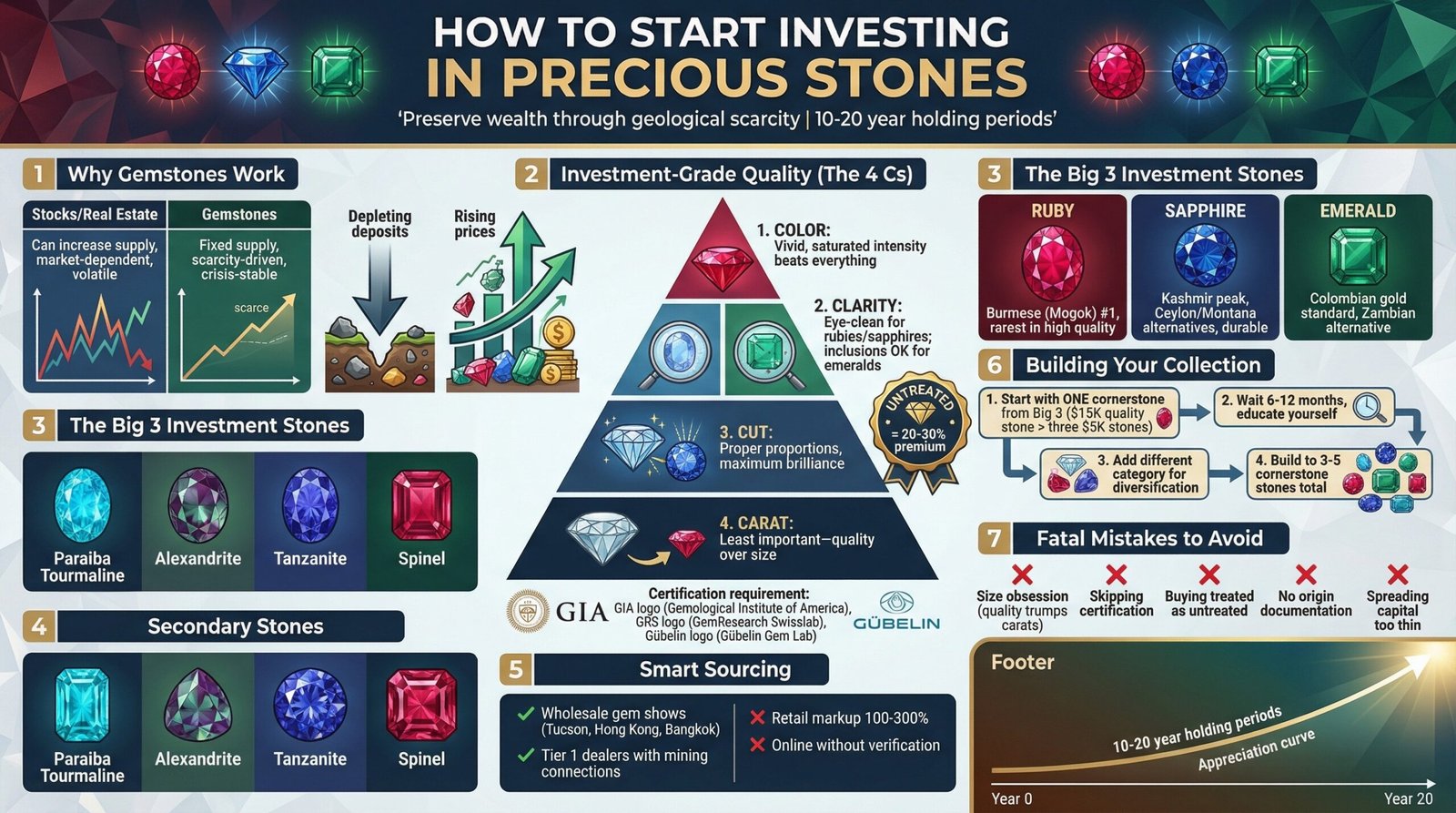
The goal of investing in precious stones is to preserve wealth through tangible assets that don’t correlate with traditional markets, while capturing appreciation driven by geological scarcity. A well-chosen gemstone can sit quietly in your portfolio for decades, appreciating steadily as comparable material disappears into private collections and museum vaults.
This leads to the question: How to start investing in precious stones?
To start investing in precious stones, you’ll need to understand which stones actually qualify as investment grade, how to assess quality through professional standards, where to source stones at prices that allow for profitable resale, and how to build a collection that balances concentration with strategic diversification. You’ll also need patience because this market rewards long-term thinking over quick flips.
Why Gemstones Work as Investments
Some investors struggle with the same misconception for years. They assume gemstones behave like stocks or real estate, responding to interest rates, GDP growth, or market sentiment.
Gemstones operate according to rarity mechanics, and that’s what makes them compelling for serious portfolios.
When you buy shares of a company, you’re betting on management execution, competitive dynamics, and macroeconomic conditions. When you buy a certified Burmese ruby, you’re acquiring a physical object that took millions of years to form under specific geological conditions that no longer exist in accessible deposits.
The Mogok Stone Tract in Myanmar, which produces the world’s finest rubies, has been mined for over 500 years.
The easy material is long gone, and what stays gets harder and more expensive to extract every single year.
Scarcity creates predictable price pressure over time. Unlike stocks, where companies can issue more shares, or real estate, where developers can build more properties, nobody can manufacture more high-quality Burmese rubies.
The supply is fixed and shrinking while demand from wealthy collectors in Asia, the Middle East, and established Western markets continues to grow.
The mathematical outcome is straightforward and favorable.
The diversification benefit matters equally. During the 2008 financial crisis, when stocks crashed and real estate collapsed, high-quality colored gemstones held their value remarkably well.
They didn’t boom because gemstones rarely do, but they didn’t crater either.
That stability during crisis periods represents genuine portfolio insurance you can physically hold in your hand.
There’s also something deeply satisfying about owning a gemstone that you’ll never experience with a brokerage statement. You can examine it under different lighting conditions, appreciate how millions of years of geological processes created that specific arrangement of chromium atoms that gives a ruby its red color, and know that you’re holding something genuinely irreplaceable.
That tangibility matters more than most financial advisors think.
Understanding Investment-Grade Quality
Not every gemstone qualifies as investment grade. This distinction separates profitable acquisitions from expensive mistakes and is based on specific, measurable criteria.
Investment-grade gemstones must meet professional standards across four evaluation criteria. Carat weight matters, but it’s actually the least important factor for investment purposes.
Investors can waste money on large stones with mediocre color simply because the size impresses them.
A 1-carat ruby with exceptional color saturation and clarity will outperform a 3-carat ruby with washed-out color almost every time.
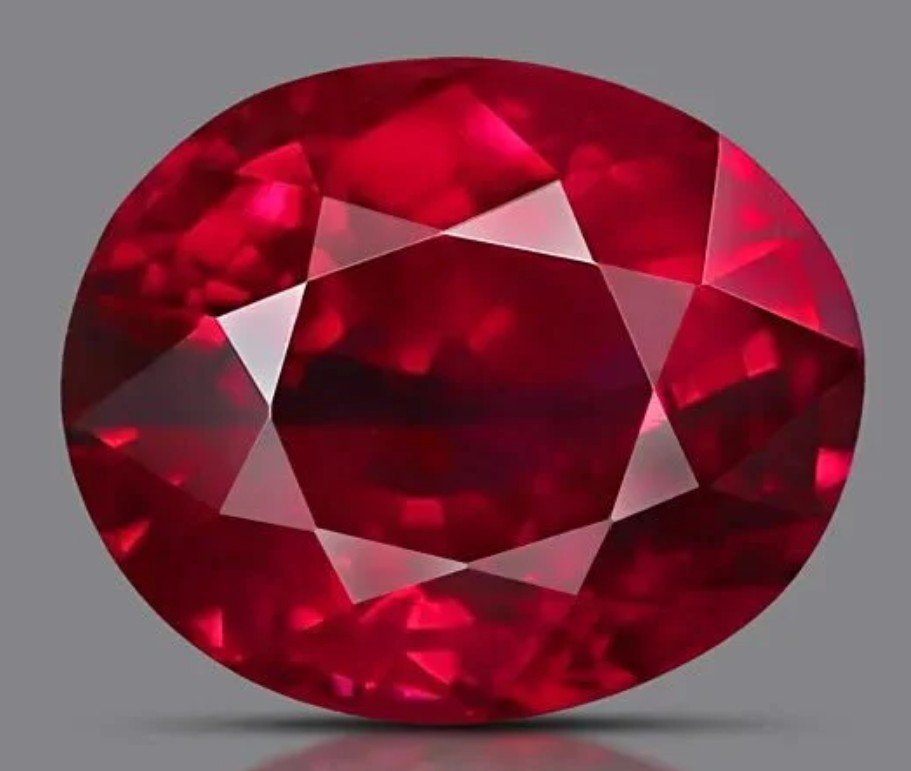
Color intensity drives value more than any other single factor. In rubies, you’re looking for deep, vivid red with slight purple undertones, what the trade calls “pigeon blood” when it reaches peak saturation.
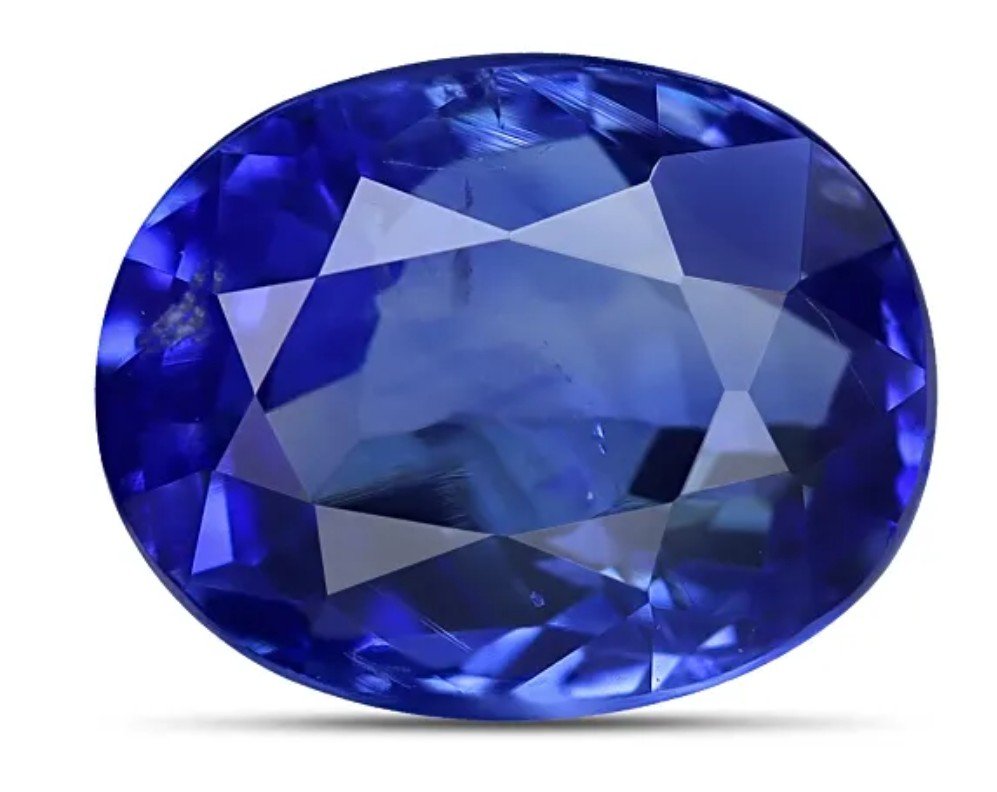
In sapphires, you want rich, velvety blue without excessive darkness or grayish secondary tones.
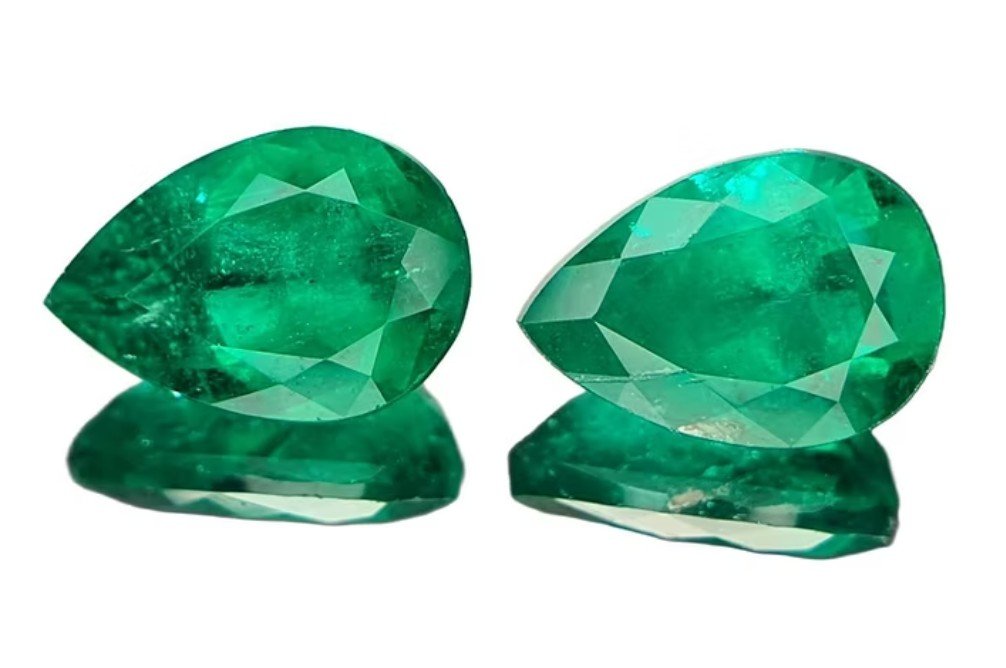
For emeralds, vivid green with balanced yellow and blue components represents the ideal. Pale or overly dark stones command a fraction of the price compared to stones with optimal color.
Clarity decides how light moves through the stone, affecting brilliance and visual appeal. Emeralds naturally contain inclusions, which the trade calls “jardin” (French for garden), so perfect clarity in emeralds is essentially impossible and not expected. But rubies and sapphires should be eye-clean at least for investment purposes, meaning no visible inclusions without magnification.
Stones with visible inclusions lose value rapidly and become difficult to resell at reasonable prices.
Cut quality affects how effectively the stone displays its color and how much light returns to your eye. Poor cutting can reduce a stone’s value by 20% or more, even when the rough material was exceptional.
You want proportions that maximize brilliance and proper facet alignment, creating even color distribution across the entire stone.
The distinction between natural, untreated stones and treated stones represents the most financially significant factor that most beginners overlook. Heat treatment, irradiation, fracture filling, and other enhancement methods are widespread in the gemstone trade.
Many treatments are permanent and stable, so treated stones can serve perfectly well in jewelry.
But for investment purposes, untreated stones command premiums of 20-30% or more because collectors prize them for their natural state.
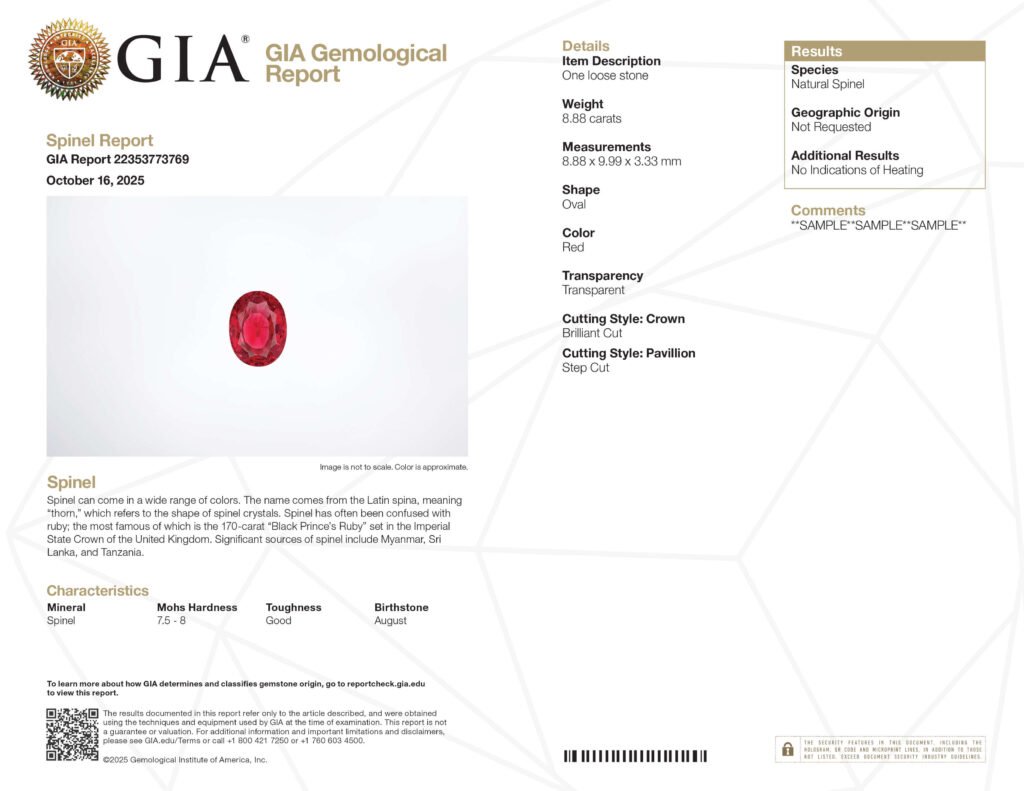
Every investment-grade gemstone needs certification from an independent laboratory. The Gemological Institute of America (GIA) sets the standard, though other reputable labs, such as GRS and Gübelin, specialize in colored stones.
These certificates document origin, treatment status, and quality assessment across all four Cs.
They’re the foundation of liquidity and resale value.
Which Stones Actually Merit Investment Capital
The investment-grade gemstone market is heavily concentrated on three primary stones: ruby, sapphire, and emerald. This concentration exists for solid reasons that have held true across decades of market data.
Ruby represents the rarest of all colored gemstones in high quality. Large, clean, richly colored rubies appear less often in nature than comparable diamonds, and this rarity translates directly into price appreciation.
Burmese rubies command the highest premiums, particularly stones from the Mogok Valley with documented provenance.
Mozambique has emerged as a secondary source producing quality rubies at more accessible price points, though Burmese material still dominates the top tier of the market.
I particularly appreciate rubies for their universal cultural appeal. Unlike some gemstones that trend in and out of fashion, rubies have maintained a premium status across Asian, Middle Eastern, European, and American markets for centuries.
That broad demand creates exceptional liquidity.
When you need to sell, qualified buyers exist.
Sapphire offers investors larger sizes with consistent quality at various price points. The legendary Kashmir sapphires, mined briefly in the late 1800s, represent the absolute peak of the market, but Ceylon (Sri Lankan) sapphires and Montana sapphires provide excellent alternatives.
Sapphire’s exceptional durability (rating 9 on the Mohs hardness scale) means stones can be worn regularly without concern for damage, and their deep blue color appeals to conservative buyers who might find other colored stones too bold.
Market analysis suggests sapphires now offer compelling value relative to rubies and emeralds. Prices have been rising but not at the same rate as top-tier rubies, creating what analysts call “catch-up potential” over the next decade.
For investors entering the market now, sapphires deserve serious consideration as cornerstone pieces.
Emerald brings historical prestige and instant recognition. Colombian emeralds from Muzo and Chivor remain the gold standard, though Zambian emeralds have gained respect for their slightly bluish-green color and often superior clarity.
Emerald’s natural inclusion patterns mean truly clean stones are exceptionally rare and command enormous premiums.
The deep green color is unmistakable and culturally significant across many civilizations dating back thousands of years.
Beyond the big three, several secondary stones merit attention once you’ve developed knowledge and secured primary positions. Paraiba tourmaline from Brazil displays electric blue and green colors unlike any other gemstone, driven by its copper content, which creates a neon-like saturation.
These stones have appreciated dramatically since their discovery in the 1980s, and supply remains extremely limited.
Alexandrite’s color-changing properties (green in daylight and red under incandescent light) make it a favorite among serious collectors. Russian alexandrite commands the highest prices, though Brazilian and Sri Lankan material offer quality at lower entry points.
The dramatic color shift creates a unique visual experience that photographs poorly but impresses tremendously in person.
Tanzanite comes from a single source in northern Tanzania, and export restrictions combined with deposit depletion create legitimate scarcity concerns. The blue-violet color appeals to buyers seeking something distinctive, and the single-origin story adds collectibility.
Tanzanite can be viewed as a reasonable diversification choice for portfolios already anchored by primary stones.
Spinel deserves special mention because it’s been historically undervalued but is rapidly correcting upward. High-quality cobalt blue spinels from Sri Lanka now command prices exceeding many sapphires, and fine red spinels rival ruby pricing.
Spinel forms in the same deposits as ruby and sapphire, often confused with them historically, but possesses its own distinct properties and appeal.
How to Source Stones Without Overpaying
Your purchase price decides everything. If you pay retail prices, you’ve already built in a loss that might take a decade or more to overcome.
Retail jewelers mark up gemstones substantially, often 100-300% above wholesale costs, because they’re selling finished jewelry, store ambiance, and convenience. That business model works fine for engagement rings and birthday gifts, but it’s incompatible with investment goals.
You need wholesale or near-wholesale pricing to create the margin of safety that allows profitable resale.
The ideal source is Tier 1 dealers: companies or individuals who mine, cut, and trade stones directly, with few intermediaries. These dealers maintain relationships with mining operations in source countries, employ their own cutters to maximize value from rough material, and sell to collectors, jewelers, and investors at wholesale or modest markup pricing.
Finding these dealers needs research and networking. Attend major gem shows like Tucson, Hong Kong, or Bangkok, where dealers congregate and trade primarily wholesale.
Join gemological societies and collector organizations where serious buyers share information and referrals.
Study auction results from Sotheby’s, Christie’s, and specialized colored stone auctions to understand current market pricing for comparable material.
When evaluating potential dealers, look for specific indicators of expertise and integrity. They should explain why a particular stone suits your investment goals, comparing it transparently to choice choices with different trade-offs.
They should discuss both strengths and limitations honestly.
They should possess deep knowledge about specific origins, mining conditions, treatment detection, and market trends across many stone categories.
Be extremely cautious of dealers who pressure quick decisions, guarantee specific returns, or seem more interested in moving inventory than understanding your goals. The best dealers sometimes talk clients out of purchases, suggesting they wait for better material or reconsider budget allocations.
That long-term relationship orientation shows someone who values reputation over quick profits.
Online marketplaces present significant verification challenges. Photographs rarely capture accurate color, and without physical examination, assessing cut quality and clarity becomes nearly impossible.
It’s not recommended to buy investment-grade stones online unless you’re working with established dealers you’ve already vetted in person and who offer generous return policies.
Building Your First Collection
Starting a gemstone collection needs a clear framework. The most successful investors follow a methodical approach that prioritizes quality and strategic diversification over accumulation.
Your first acquisition should be a cornerstone stone from the big three. This decision carries more weight than subsequent purchases because it establishes the foundation of your collection and represents your largest capital commitment.
Choose the stone that genuinely appeals to you aesthetically because you’ll hold it for years and should enjoy looking at it.
But make that choice from within the investment-grade category where color, clarity, and certification meet professional standards.
Budget considerations matter, obviously, but the principle of concentration outweighs the temptation to spread capital across many lesser stones. A single $15,000 certified Burmese ruby with excellent color and clarity offers a better investment than three $5,000 rubies with compromised color and clarity.
The exceptional stone appreciates more reliably and sells more easily when the time comes.
Origin documentation provides crucial value support, particularly for premium categories. Burmese rubies command premiums over Mozambique rubies even when visual characteristics are comparable.
Kashmir sapphires trade at multiples of those of Ceylon, of similar size and color.
Colombian emeralds consistently exceed Zambian prices. These origin premiums continue because collectors value provenance and historical associations, creating predictable demand patterns.
Treatment status deserves careful consideration relative to budget. Untreated stones carry 20-30% premiums but offer the most appreciation potential and collectibility.
If your budget doesn’t comfortably accommodate untreated material in the size and quality you want, consider whether reducing the size while maintaining untreated status provides better long-term positioning.
A 1-carat untreated ruby often outperforms a 2-carat heated ruby as an investment, even though the larger stone might appear more impressive initially.
After establishing your cornerstone stone, resist the temptation to immediately acquire extra pieces. Let your first purchase season last for a while (six months, a year, longer if needed) while you continue educating yourself and monitoring the market.
This patience confirms that your cornerstone choice was sound, allows time for additional capital accumulation, and prevents reactive buying driven by opportunity rather than strategy.
Your second acquisition should come from a different category to begin building diversification. If you started with ruby, consider sapphire or emerald as your second stone.
If you began with sapphire, add ruby or emerald.
This cross-category approach reduces concentration risk and exposes you to different origin dynamics, color characteristics, and market segments.
Subsequent additions can incorporate secondary stones like alexandrite, tanzanite, or spinel once you’ve developed enough knowledge to assess these less common materials. Each stone should fill a distinct role in your collection rather than duplicating characteristics you already own.
Advanced Strategies for Maximizing Returns
The difference between mediocre and excellent investment outcomes comes down to subtle strategic choices that compound over time. These approaches need patience and discipline, but they’re straightforward once you understand the underlying principles.
Time horizon fundamentally shapes everything. Gemstones reward long-term thinking in ways that shorter timeframes simply don’t capture.
Holding periods of 10-15 years allow scarcity dynamics to assert themselves as comparable material gets absorbed into private collections and museums.
Mining conditions deteriorate as the best deposits reduce. New wealth in developing economies creates fresh demand for scarce materials.
All these factors work in your favor, but they unfold gradually.
Think in terms of decades. Set your mental framework to 15-20 years, and suddenly, short-term price fluctuations become irrelevant noise.
This psychological shift changes decision-making in useful ways.
You stop worrying about whether you could have bought 10% cheaper six months from now, and you start focusing on whether the stone’s basic rarity supports appreciation over two decades.
The mathematical reality of geological scarcity creates near-certainty of appreciation across sufficiently long timeframes for properly selected stones. Burmese ruby deposits continue to deplete.
Kashmir sapphire mines exhausted their primary production over a century ago, with only occasional small recoveries.
Colombian emerald mining faces increasing environmental restrictions and deposit depletion. These are permanent changes in available supply meeting stable or growing demand.
Concentration versus diversification needs balancing competing goals. Too much concentration creates a single-stone risk.
If your entire portfolio consists of one ruby, you’re vulnerable to damage, theft, or shifts in taste toward other stones.
Too much diversification spreads capital across many modest stones without enough investment-grade quality in any single piece to attract serious buyers.
The optimal approach for most investors involves building around 3-5 cornerstone stones over time, with primary emphasis on the big three and selective additions of secondary materials. This provides meaningful diversification while maintaining enough capital concentration in each piece to confirm investment-grade quality.
Documentation becomes increasingly valuable over time. Maintain comprehensive records, including purchase receipts, certification documents, photographs, and correspondence with dealers.
Store this information securely but accessibly.
When resale time comes years or decades from now, thorough documentation dramatically improves buyer confidence and supports premium pricing.
Insurance represents a necessary cost that many beginners overlook. Specialized jewelry insurance policies cover loss, theft, and damage at relatively modest annual premiums, typically 1-2% of appraised value.
Schedule specific items individually rather than relying on homeowners’ policy jewelry riders, which often carry inadequate coverage limits and restrictive terms.
Common Mistakes That Destroy Returns
Some beginners make the same costly errors repeatedly, and they’re all avoidable with proper guidance. Understanding these problems before committing capital prevents expensive lessons learned the hard way.
The size obsession represents the most common mistake. Buyers get anchored on carat weight, assuming that bigger is automatically better for investment.
This fails spectacularly in gemstones, where quality trumps size across every meaningful metric.
A 2-carat ruby with pale color and visible inclusions will underperform a 1-carat ruby with vivid color and eye-clean clarity, often by substantial margins. Market demand focuses overwhelmingly on quality stones, with size a secondary consideration once color and clarity standards are met.
Skipping certification seems like a money-saving shortcut, but it creates significant friction in the resale market. Uncertified stones need potential buyers to either trust your representation (which sophisticated buyers won’t do) or pay for certification themselves (which creates negotiating leverage working against you).
The few hundred dollars saved on upfront certification often costs thousands in reduced resale prices or lost sales entirely.
Buying treated stones as investments without understanding the implications silently destroys returns. Heat treatment in rubies and sapphires is so common that many dealers consider it standard and don’t mention it explicitly.
But untreated stones command those 20-30% premiums, and that difference compounds over long holding periods.
If you’re paying untreated prices for treated material because you didn’t verify treatment status explicitly, you’ve overpaid substantially right from day one.
Failing to verify the origin creates similar problems. A generic “ruby” or “sapphire” lacks the specificity serious collectors demand.
Burmese versus Mozambique ruby, Kashmir versus Ceylon versus Montana sapphire, Colombian versus Zambian emerald, these distinctions carry enormous pricing implications.
Origin certificates from respected labs document geographic source through chemical analysis and inclusion patterns, providing the evidence that supports premium pricing.
Spreading capital too thin across many modest stones prevents the accumulation of enough quality in any single piece to attract serious buyers. A collection of fifteen $2,000 stones rarely performs as well as three $10,000 stones, even though the total investment is the same.
The concentrated approach creates pieces with genuine liquidity and market demand, while the dispersed approach creates inventory that’s difficult to move at reasonable prices.
Emotional buying leads to collections that lack strategic coherence. Seeing an attractive stone at a show or auction and making an impulse purchase might feel exciting in the moment, but it often results in owning material that doesn’t fit your overall strategy.
Every acquisition should answer a specific question: What role does this stone play in my collection?
How does it provide diversification from what I already own? Does it meet investment-grade standards, or am I buying because I like how it looks?
People Also Asked
Are Burmese rubies worth more than other rubies?
Yes, Burmese rubies consistently command premium prices compared to rubies from other sources, even when their visual characteristics appear similar. The premium stems from collectors and investors’ valuation of Burmese origin and the Mogok Valley’s centuries-long production of the world’s finest rubies.
Mozambique has emerged as a quality source with more accessible pricing, but Burmese material still dominates the top tier of the market.
Origin documentation from reputable labs such as GIA or Gübelin is essential to support these premium prices.
What does GIA certification cost for gemstones?
GIA certification for colored gemstones typically costs between $150 and $500, depending on the stone’s size and the level of service requested. Standard service takes several weeks, while expedited service costs more but returns results faster. The certificate documents the stone’s species, variety, color, clarity, cut, carat weight, and any treatments detected. For investment-grade stones, this certification fee represents a small percentage of the stone’s value but provides essential documentation that dramatically improves liquidity and supports premium resale pricing.
How can you tell if a ruby is heat-treated?
Detecting heat treatment in rubies requires gemological laboratory equipment capable of examining internal characteristics at high magnification. Trained gemologists look for specific inclusion patterns and alterations to internal structures that show exposure to high temperatures.
Some heat-treated rubies exhibit tiny internal fractures or altered rutile silk patterns that natural rubies don’t show.
Individual buyers cannot reliably detect treatment without professional equipment, which is why purchasing certified stones from reputable labs like GIA, GRS, or Gübelin is essential for investment purposes.
What makes Kashmir sapphires so expensive?
Kashmir sapphires command extraordinary prices because they mix exceptional color quality with extreme rarity. The original deposits in the Himalayas produced stones for only a brief period in the late 1800s and early 1900s, after which they became depleted. Kashmir sapphires display a distinctive velvety blue color, caused by fine silk inclusions that create a soft, glowing appearance unlike that of sapphires from other sources.
Top-quality Kashmir sapphires now sell for $50,000 to over $200,000 per carat at auction, far exceeding prices for comparable sapphires from Ceylon or other origins.
Are Colombian emeralds better than other emeralds?
Colombian emeralds generally command the highest prices in the market because Colombia has historically produced the world’s finest emeralds with superior color and clarity. Emeralds from the Muzo and Chivor mines display a pure green color that collectors particularly prize.
However, Zambian emeralds have gained significant respect for their slightly bluish-green color and often superior clarity compared to Colombian material.
Both sources produce investment-grade stones, and the choice between them depends on personal color preferences and budget.
Do treated gemstones increase in value?
Treated gemstones typically appreciate more slowly than untreated stones and command lower prices in the investment market. While stable treatments like heat enhancement are widely accepted in the jewelry trade, collectors and investors consistently pay 20-30% premiums for untreated material.
This premium reflects the rarity of finding high-quality untreated stones and collector preference for gemstones in their natural state.
For investment purposes, untreated stones offer better long-term appreciation potential and stronger resale demand among serious buyers.
How long should you hold gemstones as investments?
Investment-grade gemstones require holding periods of 10-20 years to realize meaningful appreciation. Geological scarcity operates slowly as mining conditions deteriorate and comparable material gets absorbed into private collections.
Short-term price fluctuations matter less than long-term supply constraints and growing demand from wealthy collectors worldwide.
Thinking in terms of decades rather than years changes how you assess purchases and removes pressure to time the market perfectly. The best gemstone investments are ones you can comfortably hold for 15-20 years while scarcity dynamics work in your favor.
Key Takeaways
Gemstone investing rewards patience, knowledge, and discipline over speculation and impulse. Start with the big three (ruby, sapphire, or emerald) and build from there only after establishing a quality cornerstone stone.
Buy from wholesale sources where your purchase price creates an immediate margin of safety.
Insist on independent certification that documents origin, treatment status, and quality assessment.
Think in terms of 10-20 year holding periods, minimum, allowing geological scarcity to drive appreciation. Concentrate capital on fewer, higher-quality stones rather than accumulating many modest pieces.
Prioritize color intensity and clarity over size when budget constraints force trade-offs.
Verify treatment status explicitly and understand the premium commanded by untreated material.
Gradually build diversification across different stone types and origins. Maintain comprehensive documentation throughout ownership to support premium resale pricing.
Remember that gemstone investing combines financial goals with aesthetic enjoyment of genuinely rare objects formed over millions of years under conditions that no longer exist.
Leave a Reply